Lens Equivalency Calculator
Find the focal length that gives the same field of view across sensor and film formats
Overview
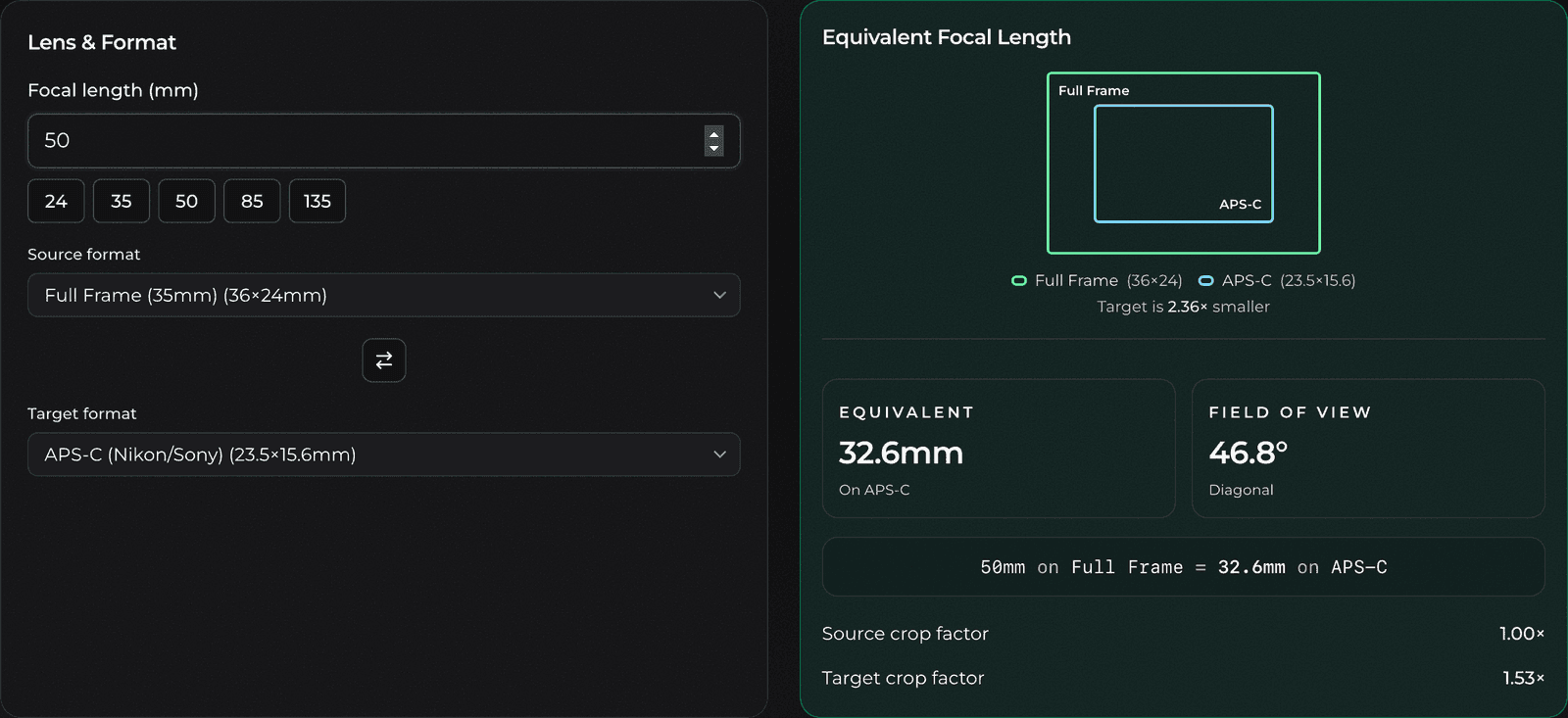
The lens equivalency calculator converts a focal length from one format to another so you get the same field of view. Tell it the lens and the format you know, pick the format you want to compare against, and it returns the equivalent focal length, the diagonal field of view, and the crop factors involved. It covers everything from Micro Four Thirds up through 8×10 sheet film, so it works whether you're switching digital systems or stepping between 35mm and large format.
Features
- Equivalent focal length matched by diagonal field of view
- Diagonal field of view for the source lens and format
- Source and target crop factors, relative to full-frame 35mm
- Focal-length presets (24, 35, 50, 85, 135mm)
- A sensor-size visualization that overlays the two formats
- One-click swap of source and target
- Digital and film formats: Full Frame, Half Frame, APS-C, Micro Four Thirds, medium-format digital, 645 / 6×6 / 6×7 / 6×9 film, and 4×5 / 8×10 sheet film
- Handles larger formats where the crop factor is less than 1
Terminology
- Focal length: The focal length of the lens, in millimeters. This is a physical property of the lens and does not change between formats; what changes is the field of view it produces.
- Format: The size of the sensor or film frame. A smaller format captures a smaller slice of the image circle, so the same lens "sees" less.
- Crop factor: How much a format crops relative to full-frame 35mm (36×24mm). It's the ratio of the full-frame diagonal to the format's diagonal. Full frame is 1.0×; APS-C is roughly 1.5×; medium and large formats are below 1.0×.
- Equivalent focal length: The focal length on the target format that gives the same diagonal field of view as your lens on the source format.
- Field of view: The angle of view the lens covers on the source format, measured across the diagonal.
Basic Usage
- Enter the focal length in millimeters, or tap a preset.
- Choose the source format: the one you know the focal length for.
- Choose the target format: the one you want to convert to.
- Read the equivalent focal length: the lens that gives the same framing on the target format.
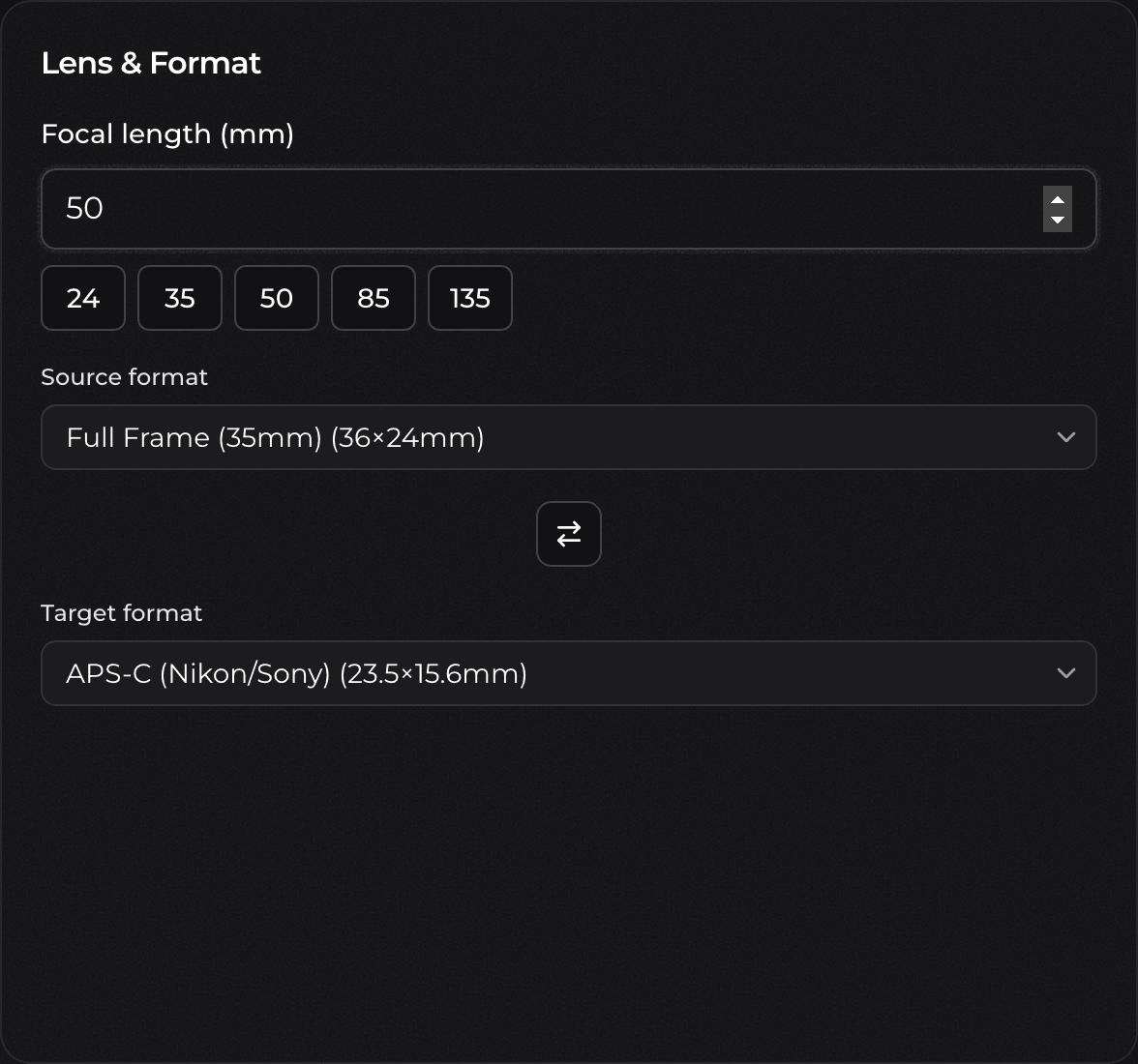
For example, a 50mm lens on Full Frame gives the same field of view as roughly a 33mm lens on APS-C:
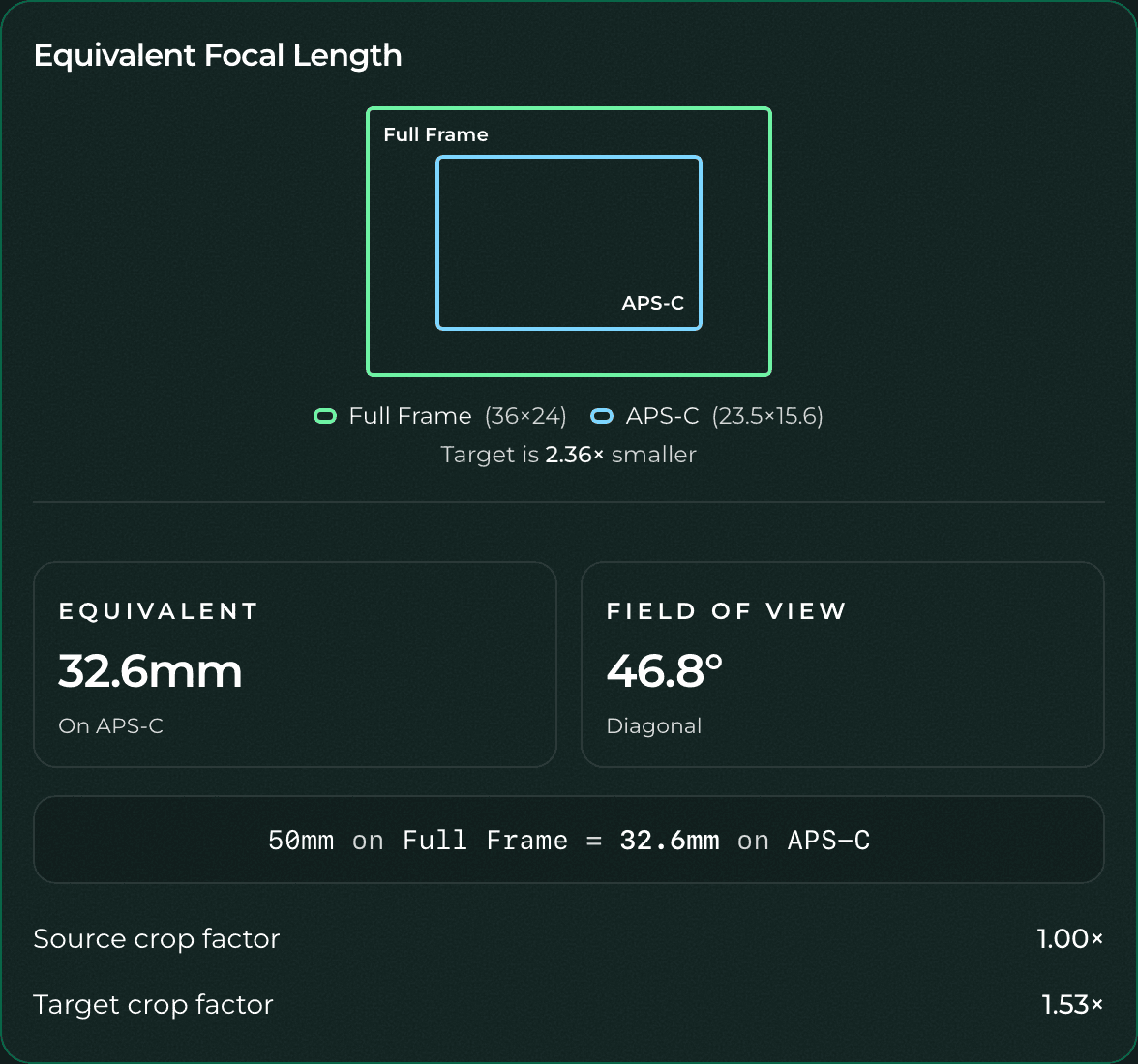
The result card shows the equivalent focal length, the diagonal field of view, a plain-language summary line, and both crop factors.
Important Notes
- Equivalence is field of view only. Matching the diagonal field of view does not match depth of field or perspective compression. A 50mm at f/2 on full frame and its equivalent on a crop sensor frame the same scene, but the smaller format renders more depth of field at the same aperture. Perspective is set by where you stand, not the format.
- Field of view is measured along the diagonal, which is why formats with different aspect ratios (say 3:2 versus 6×7) don't line up perfectly on width or height even when the diagonal matches.
- Crop factors are computed from each format's actual diagonal relative to full-frame 35mm (≈43.27mm), so the numbers reflect real sensor and film dimensions rather than rounded figures.
Advanced Usage
Swapping Source and Target
The swap button between the two format selectors flips source and target in place, keeping your focal length. It's the quick way to ask the reverse question ("what would this lens need to be on the other body?") without re-selecting both formats.
Reading the Visualization
The diagram overlays the two formats at the same scale so you can see how much larger or smaller the target frame is. The caption calls out the size relationship (for example, "Target is 2.36× smaller"), which is the same factor relating the two crop factors.
Larger Formats (Crop Factor Under 1)
Medium and large formats have crop factors below 1, so they widen rather than crop. An 80mm lens, a "normal" lens on 6×7, behaves like a much longer lens when you express it on full frame:
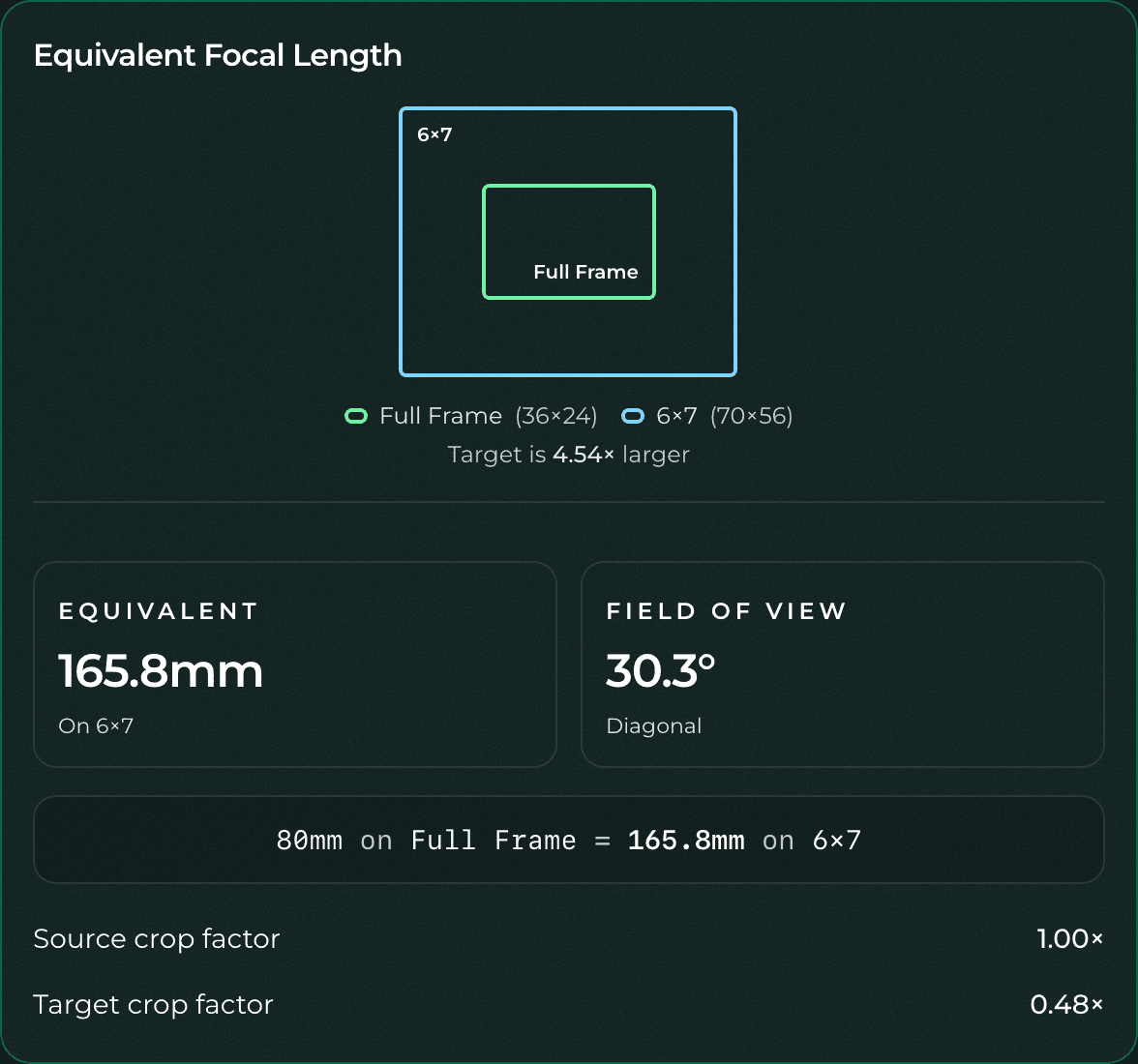
Here 80mm on Full Frame equals about 166mm on 6×7, the 6×7 frame is 4.5× larger in area terms, and its crop factor is 0.48×. This is why a 90mm on 4×5 or a 150mm on 6×7 feels "normal" despite the long-sounding number: the bigger the format, the longer the focal length needed for the same field of view.